

In most healthcare organizations, the majority of usable data never makes it into an analyst's notebook, let alone a decision-maker's hands. Teams spend up to 80% of their time finding, cleaning, and preparing information, so entire classes of questions are quietly shelved as "too hard." The opportunity cost is enormous: lifesaving insights and operational breakthroughs never see the light of day.
The MTN Data Foundry changes this dynamic. Rather than merely shaving hours off today's slow pipelines, the Foundry makes it possible—and routine—to analyze data sets that would previously have been dismissed as infeasible. By automating harmonization, governance, and security, the Foundry unlocks the long-tail of high-value but neglected projects, propelling organizations into the next era of AI-driven care.
Consider an emergency department (ED) operations team trying to reduce wait times. Despite having years of electronic health record (EHR) data, the analysts abandon many promising hypotheses because reconciling timestamps, categorizing chief complaints, and cleaning inconsistent flow data could take months. With the Foundry, those analyses move from "never" to "next week."
1. The Data Challenge & Our Vision
Healthcare data environments are complex: sensitive data, fragmented silos, inconsistent schemas, and onerous compliance requirements. A rehabilitation center might collect millions of wearable vital-sign readings each day yet struggle to correlate them with treatment interventions documented in the EHR. The required manual integration not only delays insights; it means valuable data is often ignored or discarded to save on costs.
The Foundry tackles these hurdles through an AI-native platform that proactively harmonizes sources, enables discovery, and assembles analysis-ready products on demand. Intelligence is embedded throughout the data lifecycle, reducing manual effort and turning once-inaccessible data into a strategic asset.
2. Core Principles of Our Architecture
From the instant data lands in the Foundry, a zero-trust security model wraps it in multiple layers of protection. Multi-factor authentication, field-level encryption, and purpose-based access controls govern every query, while 21 CFR Part 11–style lineage gives auditors a one-click chain of custody for each row. HIPAA, GDPR, and FDA requirements are enforced automatically—no slow-downs, no exceptions.
Beneath that shield runs a living metadata fabric that continuously discovers and connects meaning across sources. The platform sees that "BP_SYSTOLIC" from the ED monitor and "SystolicPressure" in the ICU record are the same clinical signal, or that half a dozen local drug codes all map to a single RxNorm concept. Analysts can type a plain-language question — "MAP versus vasopressor dosage over the last 12 hours" — and our data foundry assembles the dataset on the fly, complete with lineage and sensitivity tags.
Intelligent automation also drives the pipelines themselves. Declarative configurations paired with AI agents clean, enrich, and harmonize feeds before they hit a dashboard: units are converted, timestamps normalized to UTC, gaps in continuous ECG streams interpolated, and implausible vitals flagged for review. The result is a reduction in engineering toil and a boost in data trust.
Because every capability ships as a pick-and-choose microservice, organizations can adopt only what they need, when they need it. A hospital might deploy the Metadata Hub first, add the Quality Agent later, and keep the entire stack inside a secure subnet—or even an air-gapped research environment—without locking itself into a monolithic upgrade path.
These principles come to life in a three-zone architecture that turns raw feeds into secure, analysis-ready products.
3. The Architecture: Data Flow & Security
In the Data Foundry, data traverses three zones in the architecture, each adding value to the information while maintaining security controls:
The journey begins in the Ingestion Zone. The Foundry preserves raw data in its original structure and enriches it with operational metadata. For example, when vital signs arrive from wearable devices, the Foundry captures not just the measurements but also ingestion timestamps and source information. This extra context proves critical for future analysis. The Foundry also encrypts sensitive data the moment it lands and starts an access-controlled audit log immediately.
In the Harmonization Layer, data undergoes transformation to create a consistent foundation. The system standardizes units, normalizes timestamps to UTC, maps device identifiers to the master patient index, and translates proprietary metrics into standardized concepts. This creates semantically consistent data ready for meaningful analysis. Security classifications and data sensitivity tags flow with the information through each transformation, ensuring appropriate controls are maintained.
The Data Product Assembly Layer dynamically constructs analysis-ready datasets for specific use cases. When a physician requests a longitudinal view of stroke recovery, the system assembles a comprehensive dataset combining activity metrics from wearables, therapy assessments, and medication adherence into a unified timeline, guided by an understanding of the clinical question being asked. Access controls are automatically enforced based on user roles and purpose specifications, ensuring HIPAA compliance while maximizing data utility.
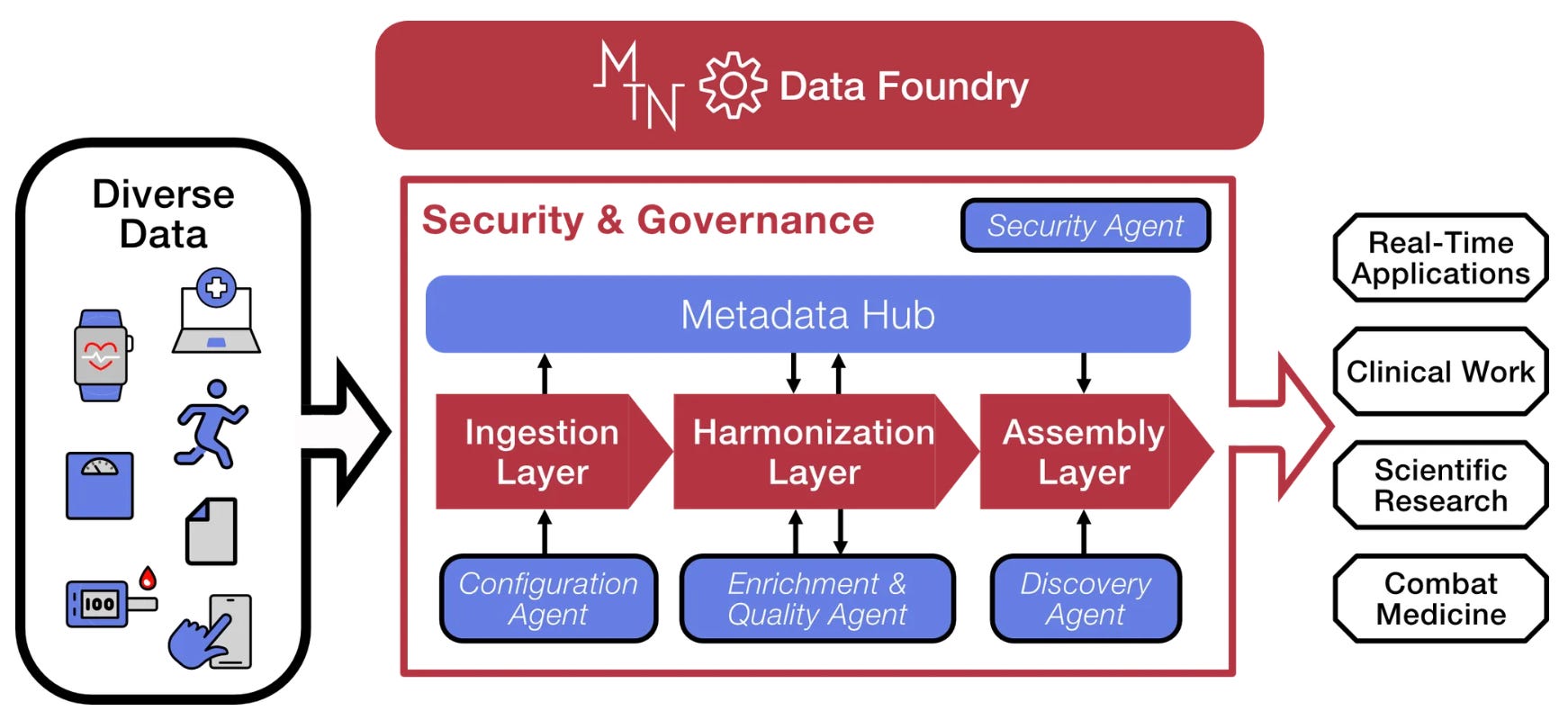
Figure 1. Three-zone architecture: External Sources → Ingestion Zone → Harmonization Layer → Data Product Assembly Layer → Consumers. All three layers are governed by a central Metadata Hub and wrapped in security controls. AI agents augment each layer of the Foundry, from ingestion configuration to continuous security monitoring.
4. Intelligent Automation: Our AI-Agent Strategy
The Foundry embeds AI throughout its core, creating a system that learns and improves over time:
Ingestion Configuration Agents analyze incoming data sources and suggest appropriate transformation rules based on data profiling, accelerating pipeline development and reducing configuration errors.
Discovery Agents enable clinicians to request datasets through natural language queries like "Show me patterns in vital signs for patients who developed pressure ulcers during ICU stay," expanding access to insights beyond technical specialists.
Metadata Enrichment Agents extract deeper meaning from data, identifying that fields labeled "MAP" likely represent Mean Arterial Pressure and automatically establishing relationships with systolic and diastolic measurements.
Quality Agents learn normal physiological relationships between vital signs, flagging potential errors by detecting unexpected patterns—like when heart rate and blood pressure relationships deviate from typical correlations.
Security Agents monitor data access patterns, identify potential misuse, and recommend improvements to security policies. They also scan for sensitive information that might be incorrectly classified, protecting against inadvertent exposure of PHI.
Together, these agents shrink analytic lead-time from months to days, as you will see in the real-world example that follows.
5. How We Transform ED Patient-Flow Analysis
To understand the impact of the Data Foundry, consider how it transforms a common healthcare challenge:
The Current Approach:
An ED operations team investigating increasing wait times faces a months-long process to analyze bottlenecks. An analyst must manually harmonize data from multiple systems—mapping patient identifiers, resolving timestamp discrepancies, and cleaning inconsistent documentation—before analysis can begin. This creates a backlog of unanswered questions and missed improvement opportunities.
With the MTN Data Foundry:
The same team browses a Data Catalog to instantly locate pre-harmonized datasets covering patient flow metrics, vital signs, and clinical interventions. They define their analysis needs through an intuitive interface: "Create a dataset of ED visits from the past six months, including triage time, vital signs, lab times, and disposition decisions for ESI levels 2-3."
Behind the scenes, the platform identifies relevant data across systems, recognizes relationships between events, aligns timestamps, and assembles a coherent timeline for each visit. Access controls automatically enforce appropriate data masking and filtering based on the analyst's role. Within minutes, the team receives a comprehensive dataset revealing patterns in lab turnaround impact on disposition decisions and staffing correlations with delays.
The result: targeted improvements implemented in days rather than months, continuous monitoring of impact, and rapid iteration on solutions—all while maintaining complete data lineage for quality assurance and regulatory compliance.
6. The Strategic Advantage
The MTN Data Foundry delivers more than technical capabilities—it creates strategic advantages for healthcare organizations:
Operational Efficiency: By automating data preparation, teams redirect resources from low-value data wrangling to high-impact analysis and innovation.
Accelerated Innovation: Ideas that previously took months to evaluate are tested in days, creating a culture of continuous improvement and faster responses to emerging needs.
Risk Reduction: Governance built into the foundation ensures compliance without creating additional work, making audits less disruptive and demonstrating responsible data practices to all stakeholders.
Maximized ROI: The platform unlocks value from data already being collected but underutilized, deriving new insights without requiring additional systems or sensors.
Enhanced Security Posture: By implementing security-by-design principles, organizations using the Data Foundry reduce their risk profile while enabling appropriate data access.
The Foundry frees healthcare experts from data preparation so they can focus on what matters most: generating insights that improve patient care and organizational performance.
Early-Access Opportunities
The Foundry is in active development, and we are inviting a select group of healthcare organizations to help shape the roadmap.
Contact us at info@themtn.ai to start the conversation.